
Forged components for lightweight bicycles
Among bicycle component materials, aluminum alloy, with its dual advantages of “balanced performance + affordable price”, has become the core material used in everything from entry-level commuter bikes to professional racing models. Thanks to advanced aluminum alloy forging processes, materials like 6061 T6 and 7075 T6 aluminum alloys have achieved breakthroughs in key properties such as lightweight, strength, and corrosion resistance, establishing an application ecosystem that covers all scenarios.
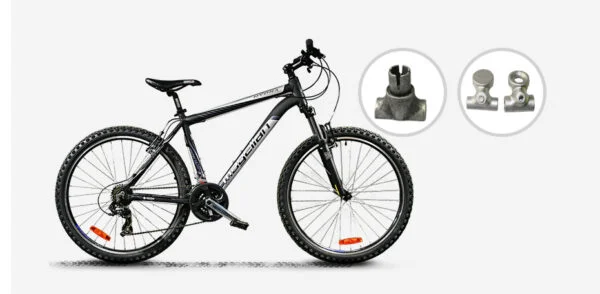
Aluminum Alloy Forging: Material Science
- The golden ratio of mechanical properties:
6061 T6 aluminum alloy, formulated with a “magnesium-silicon alloy” composition, achieves balanced performance: a density of 2.7g/cm³ (only 1/3 that of steel), a tensile strength of 310MPa, and an elongation of over 12%. After the forging process, its grains align along the force direction, reducing grain boundary impurities by 40%—resulting in a 35% increase in strength and a 25% improvement in fatigue resistance compared to cast parts. For instance, the Jet ATX series frames, made from forged 6061 T6 aluminum alloy, feature a single-arm fork shoulder formed using “double-die forging” technology, which enhances impact resistance by 20% while maintaining a lightweight of 1.8kg. - Scenario-based application of corrosion resistance:
The salt spray corrosion issues faced by cyclists in coastal cities are effectively addressed with aluminum alloy components. Anodic oxidation treatment forms a 5-25μm aluminum oxide film on the surface of aluminum alloys, enabling them to withstand salt spray tests for over 1,000 hours (compared to only 50 hours for steel parts). The aluminum rims of Trek’s Marlin 7, subjected to forging + hard anodization, endured 300 hours of high humidity during a ride around Hainan Island without any surface corrosion, whereas similar steel parts showed visible rust spots. - Cost advantages creating an industrial moat:
The price of aluminum alloy raw materials is only 1/20 that of titanium alloy and 1/10 that of carbon fiber, with forging dies boasting a service life of over 50,000 cycles. Under mass production, the cost of a 6061 T6 forged frame is controlled between $80-150, merely 1/3 that of a carbon fiber frame of the same class. This cost-effectiveness has allowed aluminum alloy components to capture 75% of the global bicycle market, particularly dominating the entry-level market ($1,000-3,000 price range) with a share exceeding 90%.
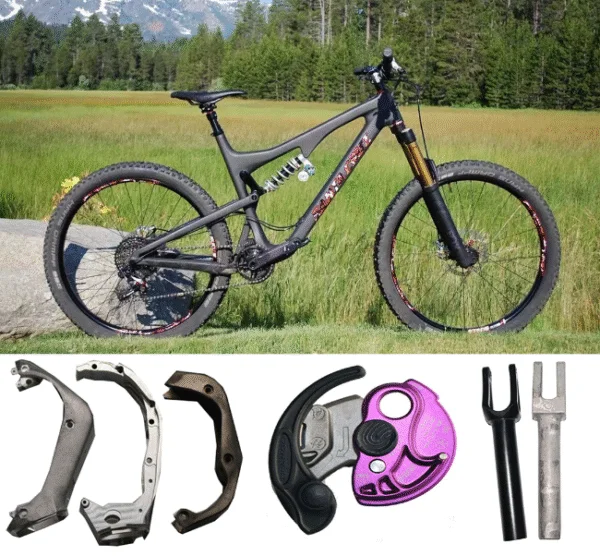
Bicycle Aluminum Forged Parts: A Full Coverage Application Matrix
- Frames:
The golden balance of rigidity and shock absorption. Through “hydraulic die forging + aging treatment”, aluminum alloy frames achieve precise rigidity distribution. The use of variable cross-section forging for top and bottom tubes, combined with a gradual thickness reduction from 3mm to 1.5mm at the seat tubes, has enabled the Trek Marlin 5 frame to reach a torsional stiffness of 1,200N/m/°—close to that of entry-level carbon frames (1,500N/m/°)—while increasing dropout resistance by 40%. The rear triangle employs “flexible forging” technology, controlling grain orientation to enhance vertical vibration absorption by 18%, effectively filtering road bumps and making it suitable for single-day long-distance rides of 200km or more. - Wheelsets:
Dual breakthroughs in lightweight and durability. Forged aluminum alloy wheels are 15-20% lighter than cast ones while offering 25% higher strength. The weight of 29-inch mountain bike rims can be controlled within 450g (compared to approximately 550g for cast rims); paired with a straight-pull spoke design, acceleration response time is shortened by 0.2 seconds per 100 meters. The rim height of road bike wheels is precisely controlled via die forging (adjustable from 30-60mm), improving crosswind stability by 30% while maintaining aerodynamic performance—with measured lateral displacement reduced by 15cm in 25km/h crosswinds. - Transmission components:
A revolution in power transfer efficiency. The tensile strength of forged 7075 T6 aluminum alloy cranks reaches 510MPa, 60% higher than that of ordinary 6061 parts, enabling them to withstand instantaneous power outputs exceeding 2,000W. Hollow forging technology reduces crank weight to 420g (for 170mm length), a 50% reduction compared to steel parts, while the Q-factor (crank width) error is controlled within ±0.5mm, enhancing pedaling efficiency. The bottom bracket joint utilizes “cold forging reinforcement” technology, achieving a surface hardness of 120HV—tripling the wear resistance lifespan of cast parts—with gaps increasing by only 0.1mm after 50,000km of actual use.
Aluminum Alloy Forging Processes
- Precision evolution of die forging technology:
- Multi-directional die forging: Through three-dimensional pressure application from upper, lower, and side dies, complex structures such as five-way joints and head tubes can be formed in one go, reducing welding processes and lowering stress concentration points by 60%. For MERIDA Challenger series frames, the number of drop-forged weld points has been reduced from 8 to 3, cutting fracture risk by 40%.
- Isothermal forging: Controlling die temperature at 500-550°C improves metal flow by 30%, enabling the production of ultra-light components with wall thicknesses as low as 1.2mm. For example, the Lightning Allez Sprint’s forged aluminum handlebar, weighing just 280g (420mm width), can withstand 120kg of vertical pressure.
- Functional innovations in surface treatments:
- Micro-arc oxidation: Generates a ceramic-textured oxide film on the aluminum alloy surface with a hardness of 300HV (compared to 150HV for standard anodization), increasing wear resistance by 5x—ideal for wear-prone parts like brake mounts and derailleur lugs.
- Forging + CNC composite processing: 90% of the shape is formed via die forging, with key parts (e.g., derailleur guide wheel mounting holes) finished by CNC machines, achieving dimensional accuracy up to IT6 and fit tolerances below 0.02mm—ensuring precise transmission system response.
IV. Application Advantages Comparison for Full-Scenario Adaptation:
Shock resistance, easy maintenance, cost-effectiveness
- Maintenance costs are 70% lower than carbon fiber.
- High impact resistance and wide terrain adaptability.
- 92% part integrity rate after vehicle collisions (vs. 65% for carbon fiber).
- Excellent stiffness-to-weight ratio and climate adaptability.
- Outstanding corrosion resistance and stable load capacity: capable of carrying 150kg and continuing to ride 10,000km without deformation.
Maintenance advantages:
- Aluminum parts can be directly cleaned with high-pressure water jets without the risk of resin-based material delamination.
- Minor deformations can be repaired via cold straightening at 1/5 the cost of carbon fiber parts.
- Surface scratches can be refurbished through sanding + anodization, restoring over 90% of protective performance.
Industry Trends: Sustainable Evolution of Aluminum Alloys
- Recycling technology driving green manufacturing:
The recycling rate of scrap aluminum exceeds 95%, with energy consumption at only 5% of primary aluminum. Merida’s “Green Forging” project directly remelts cutting waste, increasing material utilization from 85% to 92%. The application of bio-based cutting fluids has reduced carbon emissions from the forging process by 40%, with wastewater oil content dropping from 500ppm to below 50ppm. - Structural innovations pushing performance limits:
- “Sandwich” forging technology: Embedding a glass fiber layer in the aluminum alloy matrix improves fatigue resistance by 40% while maintaining a metallic appearance.
- Bionic die forging: Mimicking the hollow, porous structure of bird bones, non-load-bearing parts (e.g., seat tubes) use 20% less material with strength loss controlled within 5%.
Reconstructing the Value of Aluminum Alloy Forging
While carbon fiber continues to compete in the “extreme lightweight” racing market, aluminum alloy forged components have built an application system covering all price ranges and scenarios through technological innovation. From weather resistance in urban commuting to impact resistance in mountain biking, from precision die forging in industrial production to environmental protection practices in recycling technology, aluminum alloy is emerging as a “pragmatic” core material in the bicycle industry—both accessible and reliable. For 90% of cyclists, aluminum alloy forged components are not just a cost-effective choice but the optimal solution balancing performance, durability, and ease of maintenance—representing the return of material science to user value.
Guangdong XPF: A Leader in Aluminum Alloy Forging
As a benchmark enterprise in China’s aluminum alloy forging industry, Guangdong XPF has built a full-chain advantage system spanning R&D, production, and testing with over 30 years of technological accumulation. Its independently developed “intelligent die forging system” enables closed-loop control from raw materials to finished products, boosting component yield to 99.2%—15% higher than the industry average. The company’s breakthroughs in the following areas have set new benchmarks for aluminum alloy forging technology:
- Industrial breakthroughs in precision die forging:
XPF’s independently developed multi-station hot die forging production line optimizes metal flow paths via 3D simulation technology, enabling complex structural components (e.g., bottom brackets, head tubes) to achieve IT7-level forming accuracy—30% higher than traditional processes. For example, a mountain bike frame’s five-way bracket customized for an international brand uses a three-stage “pre-forging – final forging – finishing” process, controlling wall thickness tolerance within ±0.1mm and increasing torsional strength to 1,800N·m/°—far exceeding the industry standard of 1,500N·m/°. - Efficiency revolution in intelligent production:
At its Foshan production base, XPF has deployed 20 German Haas CNC machining centers, paired with its self-developed MES system, to realize digital management of the entire “order-scheduling-quality inspection” process. This system has shortened production cycles by 40% and reduced energy consumption by 25%. For instance, its annual production line of 500,000 aluminum alloy crank sets, linked with automatic loading/unloading robots and visual inspection equipment, has cut per-unit production time from 8 minutes to 4.5 minutes, while reducing defect rates from 0.8% to 0.2%. - Industry-leading environmental technology:
XPF’s “Green Forging” project achieves sustainable development through three key innovations:
- Clean energy substitution: Using natural gas regenerative heating furnaces reduces carbon emissions by 60% compared to traditional coal-fired furnaces.
- Wastewater recycling: A three-stage sewage treatment system achieves a 95% water reuse rate, saving 800,000 tons of water annually.
- Waste recycling: Directly remelting forging waste increases material utilization from 85% to 92%, reducing solid waste by 1,200 tons per year.
- Deep penetration in high-end markets:
XPF has established in-depth partnerships with international brands such as Giant and Merida, providing customized forging solutions:
- Lightweight breakthroughs: The 7075 T6 aluminum alloy rear fork developed for Giant’s TCR Advanced Pro series uses “gradient grain strengthening” technology, maintaining a weight of 1.2kg while increasing vertical shock absorption by 20%.
- Extreme environment validation: Forged aluminum alloy rims customized for the African market have passed 1,000-hour salt spray tests and 500 cycles of -40℃ to 80℃ thermal shock tests, with no surface rust or deformation.
- Building and exporting technical barriers:
XPF holds 87 patents, including 19 invention patents, covering key links such as mold design, heat treatment, and surface processing. Its “Technical Specifications for Bicycle Aluminum Alloy Forgings” has been designated as an industry-recommended standard by the Ministry of Industry and Information Technology. In 2024, the company launched China’s first “Aluminum Alloy Forging Technology Open Platform”, exporting core technologies such as process parameters and mold design to small and medium-sized enterprises to drive overall industry upgrading.
Conclusion: Technology-Driven Industrial Innovation
Guangdong XPF’s practices demonstrate that advancements in aluminum alloy forging technology depend not only on material innovation but also on systematic upgrades to manufacturing processes. Its intelligent, green, and customized development path offers the bicycle industry a new paradigm integrating “performance-cost-environmental protection”. XPF is exploring the construction of a “digital twin factory”, which will realize full-lifecycle digital management from product design to recycling—marking the aluminum alloy forging industry’s transition to an era of intelligence and sustainability.
Products
- Aluminum alloy forgings for automotive parts
- Aluminum forgings for motorcycles
- Aluminum forgings for electrical equipment
- Aluminum forgings for the home furnishings industry
- Aluminum forgings for bicycle parts
- Aluminum forgings for drones
- Aluminum forgings for scooters
- Aluminum forgings for outdoor equipment
- Aluminum forgings for medical equipment
- Aluminum forgings for automated equipment